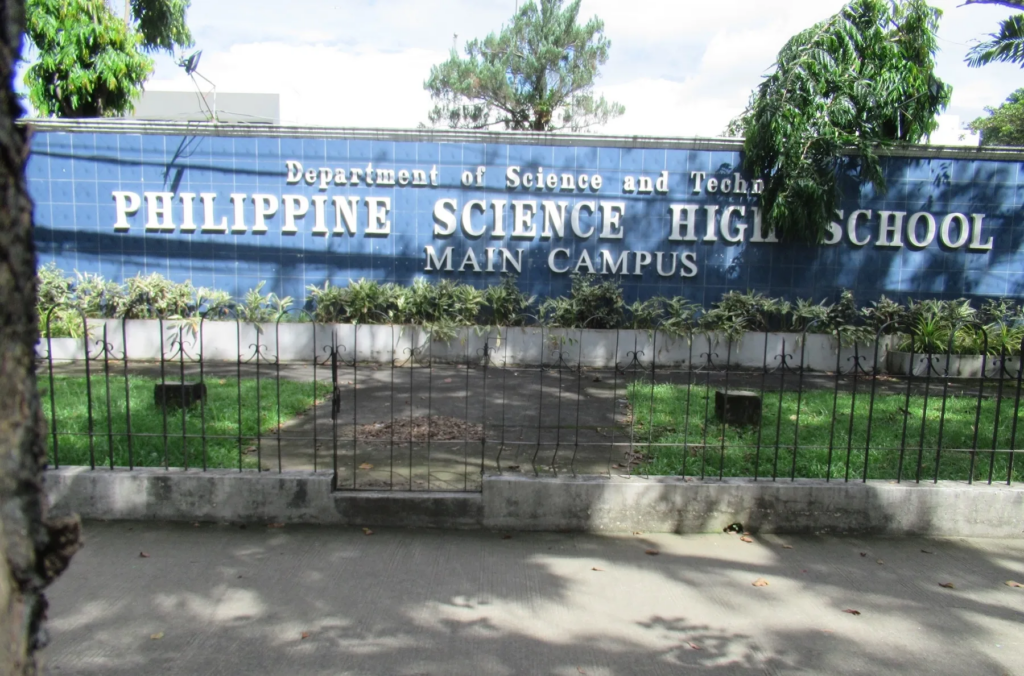
MANILA — In an effort to modernize scientific teaching and unify admissions across science high schools, the Department of teaching (DepEd) has launched the first-ever Unified scientific High School Admission Test (USHAT) in the National Capital Region.
The traditional practice of each science high school administering its own entrance exam is replaced by the new system.
According to DepEd, the unified approach guarantees fairness and uniformity in assessing students’ preparedness for advanced science and mathematics because all applicants take the same exam.
On Saturday, March 7, over 8,831 sixth-graders from 18 science high schools in Metro Manila took the computer-based test to be admitted to Grade 7 for the 2026–2027 school year.
“This is limited to the National Capital Region because we wanted to follow or align with the secretary’s five-point reform agenda regarding digitalization, as regards ensuring that our science high school students are really at par with science high school students in the world,” stated Jocelyn Andaya, assistant secretary for operations in the Department of Education and director of the NCR, on Wednesday.
According to DepEd, the test uses a competency-based evaluation that emphasizes higher-order thinking skills to gauge pupils’ preparedness for demanding science education.
The University of the Philippines National Institute for Science and Mathematics Education Development (UP NISMED), which also helped with the exam’s data processing and evaluation, collaborated on the development of the test items.
Site inspections, system load testing, examiner and IT staff orientation sessions, and the deployment of technical support teams in testing facilities were all part of the preparations for the pilot implementation.
IT personnel were allocated to each testing site, according to DepEd, and backup PCs and laptops were ready to handle any technical issues.
GLITCHES IN TECHNOLOGY
Technical issues were noted during the examination despite preparations, primarily at Quezon City Science High School, where over 600 pupils took it.
According to DepEd, the problems were promptly fixed, and impacted students were offered the choice to retake the test at a later time or continue with more time.
Some students chose to retake the examination on Monday, March 9, after being given the option to finish it with more time.
“90 PERCENT” READY
DepEd calculated that the pilot run’s preparations were roughly 90% complete.
Earlier, several parents expressed worries that applicants were taken aback by the change to a single, computer-based exam.
However, according to DepEd, announcements had been made months before the test.
EXAM RESULTS RELEASED Faster
Because scores are created automatically, officials anticipate that the computer-based assessment will increase transparency and expedite the dissemination of findings.
In order to improve the procedure and address issues in subsequent tests, DepEd intends to carry out a post-examination evaluation including schools, test takers, and parents.
In order to give parents and kids more time to prepare, the agency also stated that earlier announcements for the test next year will be issued, potentially as early as September of this year.
The unified scientific high school admission test may potentially be introduced in other areas as well, acting as a model for national adoption if the NCR experiment is successful.
RELATED VIDEOS: